Navigating 2026 Federal Student Aid: FAFSA Changes & Your Financial Future

The landscape of higher education funding is constantly evolving, and for prospective students and their families, staying abreast of these changes is paramount. As we look towards the 2026 academic year, significant modifications to the federal student aid system, particularly concerning the Free Application for Federal Student Aid (FAFSA), are set to reshape how millions access financial assistance. Understanding these changes to 2026 Federal Student Aid is not just beneficial; it’s essential for maximizing your opportunities and securing the funding you need for your educational aspirations.
This comprehensive guide aims to demystify the upcoming alterations, providing you with a clear roadmap to navigate the complexities of 2026 Federal Student Aid. We’ll delve into the FAFSA Simplification Act, explore new eligibility criteria, offer strategic application tips, and discuss how these changes might impact your financial aid package. Our goal is to empower you with the knowledge to approach the application process confidently and effectively.
Understanding the FAFSA Simplification Act: A New Era for 2026 Federal Student Aid
The FAFSA Simplification Act represents the most substantial overhaul of federal student aid in decades. Enacted to streamline the application process and expand eligibility, its full implementation will significantly impact how students apply for and receive 2026 Federal Student Aid. While some changes have already been rolled out, the 2026 cycle will see the complete picture of these reforms.
Key Changes Introduced by the Simplification Act
Several pivotal modifications are at the heart of the FAFSA Simplification Act:
- Simplified Application Form: The FAFSA form itself has been dramatically shortened, reducing the number of questions from over 100 to approximately 36. This aims to make the application less daunting and more accessible for all applicants seeking 2026 Federal Student Aid.
- Expanded Eligibility for Pell Grants: One of the most impactful changes is the expansion of Pell Grant eligibility. The new formula uses the Student Aid Index (SAI) – replacing the Expected Family Contribution (EFC) – and considers factors like family size and poverty levels to determine eligibility more inclusively. This means more students, especially those from low-income backgrounds, will qualify for maximum Pell Grant awards.
- Direct Data Exchange with IRS: A major improvement is the direct data exchange between the IRS and the Department of Education. This allows for the automatic transfer of tax information, reducing the burden on applicants to manually input complex financial data and minimizing errors. This is a crucial aspect for accurate 2026 Federal Student Aid calculations.
- Changes to Family Definition: The definition of ‘family’ for FAFSA purposes has been updated. For divorced or separated parents, the parent who provides the most financial support to the student, rather than the parent the student lived with most, will now be responsible for providing financial information.
- Elimination of the ‘Number of Students in College’ Question: Previously, having multiple children in college simultaneously would reduce the EFC for each student. Under the new system, this question has been removed, potentially impacting the aid packages for families with multiple college-bound students.
These changes collectively aim to create a more equitable and straightforward path to obtaining 2026 Federal Student Aid. However, understanding the nuances of each modification is critical for effective planning.
Navigating the New Student Aid Index (SAI) for 2026 Federal Student Aid
The introduction of the Student Aid Index (SAI) is perhaps the most significant change for 2026 Federal Student Aid applicants. Replacing the long-standing Expected Family Contribution (EFC), the SAI is a new eligibility index used to determine a student’s financial need for federal student aid programs.
What is the Student Aid Index (SAI)?
The SAI is a number that colleges use to determine how much federal student aid you are eligible to receive. It is not the amount of money your family will have to pay for college, nor is it the amount of federal student aid you will receive. Instead, it is an index number that schools use to calculate your financial need.
A key difference from the EFC is that the SAI can be a negative number, ranging from -1500 to above 999,999. A negative SAI indicates a higher level of financial need, allowing more students to qualify for maximum Pell Grants and other need-based aid.
How is the SAI Calculated?
While the exact formula is complex, the SAI calculation for 2026 Federal Student Aid will primarily consider:
- Student’s Income and Assets: A portion of the student’s income and assets will be factored in.
- Parental Income and Assets (for dependent students): The income and assets of the student’s parents will be a major component.
- Family Size: The number of people in the household will still play a role, but its impact on the SAI calculation has been modified.
- Poverty Guidelines: The new formula incorporates federal poverty guidelines, which can significantly benefit lower-income families.
The direct data exchange with the IRS will simplify the income reporting process, making the SAI calculation for 2026 Federal Student Aid more accurate and less prone to user error.
Expanded Pell Grant Eligibility: A Game Changer for 2026 Federal Student Aid
The Pell Grant program is a cornerstone of federal student aid, providing need-based grants to undergraduate students. The FAFSA Simplification Act significantly expands eligibility for these grants, making 2026 Federal Student Aid more accessible to a broader range of students.
Automatic Maximum Pell Grants
Under the new rules, some students will be eligible for a maximum Pell Grant based solely on their family size and adjusted gross income (AGI) relative to the federal poverty line. This ‘maximum Pell eligibility’ simplifies the process and provides greater certainty for those with the highest financial need.
Minimum Pell Grants
Conversely, students whose SAI is above zero but below a certain threshold may still be eligible for a minimum Pell Grant. This ensures that even those with some financial capacity can receive assistance, broadening the reach of 2026 Federal Student Aid.
The expansion of Pell Grant eligibility is particularly impactful for students from low-income backgrounds, first-generation college students, and those attending community colleges. It aims to reduce reliance on student loans and make higher education more affordable.
Strategic Tips for Applying for 2026 Federal Student Aid
Even with a simplified FAFSA, a strategic approach to the application process can significantly enhance your chances of securing optimal 2026 Federal Student Aid.
1. Gather Necessary Documents Early
Although the FAFSA is shorter, you will still need certain documents. These typically include:
- Social Security Number (SSN) for the student and parents.
- Alien Registration Number (if not a U.S. citizen).
- Federal income tax information (W-2s, tax returns) for the relevant tax year. For the 2026-2027 academic year, this will generally be your 2024 tax information.
- Records of untaxed income (child support received, interest income, veterans noneducation benefits).
- Information on cash, savings, checking account balances, investments, and business/farm assets.
Having these documents organized before you start will make the application process for 2026 Federal Student Aid much smoother.
2. Create an FSA ID
Both the student and at least one parent (for dependent students) will need an FSA ID to access and sign the FAFSA online. Create this well in advance, as it can take a few days to process. The FSA ID is your digital signature for 2026 Federal Student Aid forms.
3. Understand the FAFSA Submission Timeline
The FAFSA typically opens on October 1st each year. While the federal deadline is usually much later, many states and individual colleges have their own deadlines that are much earlier. It’s crucial to apply as early as possible after the FAFSA opens to maximize your eligibility for state and institutional aid, which often operate on a first-come, first-served basis. For 2026 Federal Student Aid, aim to submit your FAFSA in October 2025.
4. Utilize the IRS Direct Data Exchange
The direct data exchange with the IRS is a major time-saver and error-reducer. Consent to the data exchange when prompted on the FAFSA. This will automatically import your tax information, ensuring accuracy and reducing the chances of your FAFSA being flagged for verification.
5. Pay Attention to Dependency Status
Your dependency status (dependent or independent) significantly impacts what information you need to provide. Most undergraduate students are considered dependent for FAFSA purposes. If you believe you have unusual circumstances that warrant an independent status, contact the financial aid office at your prospective schools.
6. Review Your Student Aid Report (SAR)
After your FAFSA is processed, you’ll receive a Student Aid Report (SAR). Review this document carefully for any errors. The SAR will also show your calculated Student Aid Index (SAI). If you find mistakes, correct them immediately. This is your chance to ensure all information for your 2026 Federal Student Aid is accurate.

Types of 2026 Federal Student Aid Available
2026 Federal Student Aid comes in various forms, each designed to meet different financial needs and circumstances. Understanding these types will help you better interpret your financial aid offer and plan for your educational expenses.
Grants
Grants are often considered the best form of financial aid because they do not need to be repaid. The most common federal grant is the Pell Grant, which, as discussed, will see expanded eligibility. Other federal grants include the Federal Supplemental Educational Opportunity Grant (FSEOG) for students with exceptional financial need, and Teacher Education Assistance for College and Higher Education (TEACH) Grants for those pursuing teaching careers in high-need fields.
Scholarships
While not exclusively federal, many federal programs and initiatives encourage scholarship opportunities. Scholarships are also ‘free money’ that doesn’t need to be repaid. They are awarded based on a variety of criteria, including academic merit, athletic talent, artistic ability, community service, specific majors, or even demographic factors. It’s crucial to actively search for and apply to as many scholarships as possible to supplement your 2026 Federal Student Aid.
Work-Study Programs
Federal Work-Study provides part-time jobs for undergraduate and graduate students with financial need, allowing them to earn money to help pay for educational expenses. These jobs are often on campus or with non-profit organizations, offering valuable work experience that often aligns with a student’s field of study.
Federal Student Loans
Federal student loans are funds that you must repay, usually with interest. They generally offer more favorable terms than private loans, including fixed interest rates, income-driven repayment plans, and options for deferment or forbearance. The main types of federal loans are:
- Direct Subsidized Loans: Available to undergraduate students with demonstrated financial need. The government pays the interest while you’re in school at least half-time, during your grace period, and during deferment.
- Direct Unsubsidized Loans: Available to undergraduate and graduate students, regardless of financial need. You are responsible for all the interest that accrues on the loan.
- Direct PLUS Loans: Available to graduate or professional students and parents of dependent undergraduate students. These loans can help cover expenses not covered by other financial aid. A credit check is required.
While loans require repayment, they are an essential part of the 2026 Federal Student Aid package for many students. It’s important to borrow only what you need and understand your repayment obligations.
What to Do After Submitting Your 2026 FAFSA
Submitting your FAFSA is just the first step. The period immediately following submission is crucial for ensuring you receive all the 2026 Federal Student Aid you are eligible for.
Monitor Your Email and College Portals
Colleges will use the information from your FAFSA to create your financial aid offer. They will typically communicate through email or dedicated student portals. Regularly check these platforms for updates, requests for additional documentation, or your official financial aid award letter.
Understand Your Financial Aid Award Letter
Once you receive an award letter from a college, review it carefully. It will detail the types and amounts of 2026 Federal Student Aid (grants, scholarships, work-study, loans) you’ve been offered. Compare offers from different schools to understand the true cost of attendance at each institution.
Appeal if Necessary
If your financial circumstances have changed significantly since you filed your FAFSA (e.g., job loss, medical emergency, unexpected expenses), or if you believe your initial aid offer doesn’t accurately reflect your family’s ability to pay, don’t hesitate to appeal. Contact the financial aid office directly, explain your situation, and provide any supporting documentation. Many colleges have a professional judgment process to re-evaluate aid eligibility.
Accept or Decline Aid
Your award letter will outline how to accept or decline the aid offered. You don’t have to accept all aid, especially loans. Carefully consider your needs and only accept what is necessary. For example, you might accept all grants and scholarships but only a portion of the offered loans.
The Impact of 2026 Federal Student Aid Changes on Specific Student Groups
The FAFSA Simplification Act aims for broader equity, and certain student populations are expected to see particular benefits or require specific attention.
Students from Low-Income Backgrounds
These students are likely to be the biggest beneficiaries, primarily due to expanded Pell Grant eligibility and the new SAI calculation that can result in negative values, indicating higher need. The direct data exchange also reduces barriers for families who might find complex forms challenging.
Students with Divorced or Separated Parents
The change in determining which parent’s information to use (the one providing the most financial support) will be a significant adjustment. Families in this situation need to understand this new rule to avoid delays or errors in their 2026 Federal Student Aid application.
Students with Siblings in College
The elimination of the ‘number of students in college’ question means that families with multiple children pursuing higher education simultaneously may see their SAI increase for each student, potentially reducing the amount of need-based aid. This is a critical point for these families to consider in their financial planning for 2026 Federal Student Aid.
Homeless and Unaccompanied Youth
The act simplifies the process for homeless and unaccompanied youth to receive independent student status, making it easier for them to access 2026 Federal Student Aid without needing parental information.
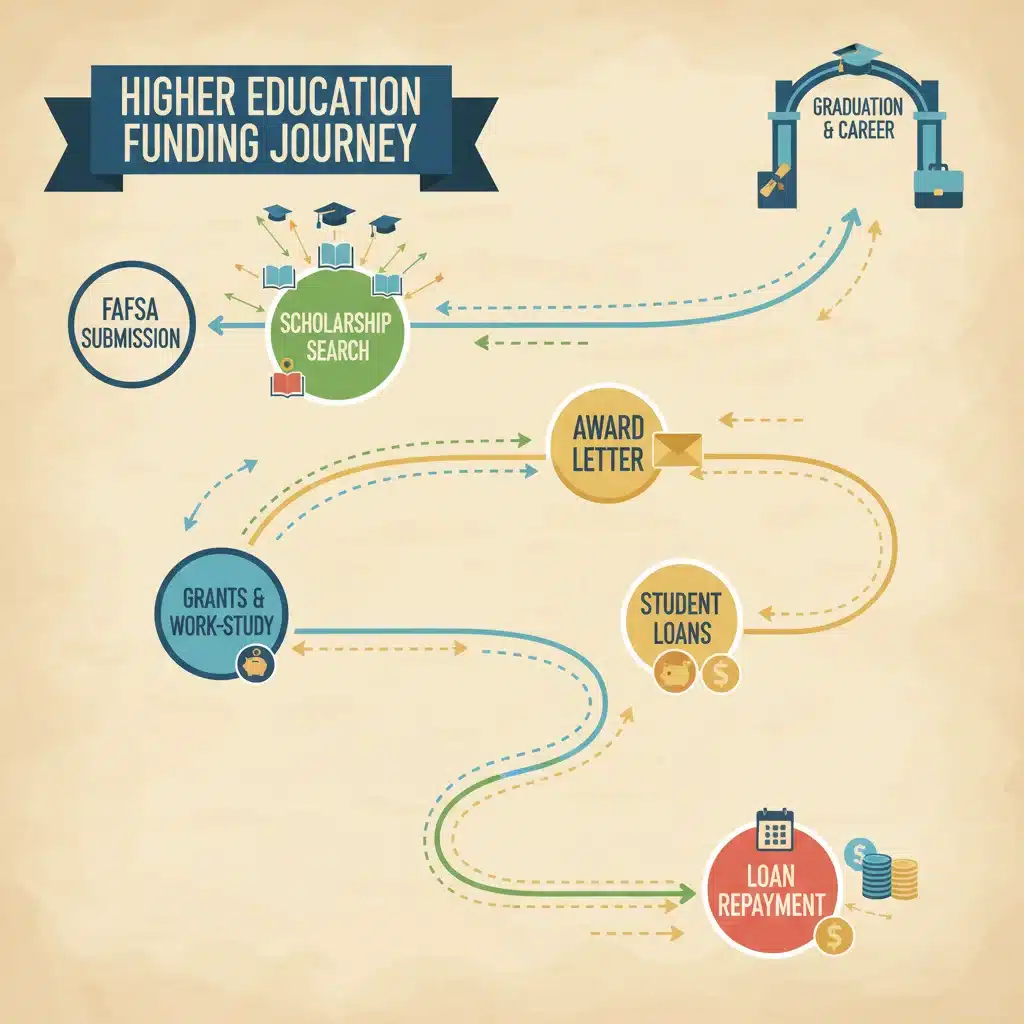
Beyond Federal Aid: Exploring Other Funding Avenues
While 2026 Federal Student Aid is a crucial component of college funding, it’s often not enough to cover the entire cost. Diversifying your funding sources is a smart strategy.
State Aid Programs
Many states offer their own grant and scholarship programs, often with their own application processes and deadlines. Check with your state’s higher education agency for specific details.
Institutional Aid
Colleges and universities often have their own endowments and funds to provide grants and scholarships. Some require additional application forms (often called CSS Profile), while others use the FAFSA data. Research each school’s specific requirements.
Private Scholarships
These are offered by various organizations, foundations, businesses, and community groups. Websites like Fastweb, Scholarship.com, and the College Board’s Scholarship Search are excellent resources. Local community organizations are also a great place to look.
Employer Tuition Assistance
If you or your parents are currently employed, check if their employers offer tuition reimbursement or assistance programs. This can be a significant source of funding.
Private Student Loans
As a last resort, private student loans are offered by banks and credit unions. They typically have higher interest rates and fewer borrower protections than federal loans. Exhaust all other aid options, including 2026 Federal Student Aid, before considering private loans.
Preparing for Your Financial Future: Long-Term Considerations
Securing 2026 Federal Student Aid is a short-term goal, but it’s part of a larger financial journey. Consider these long-term implications:
Budgeting and Financial Literacy
Learning to budget, manage debt, and understand financial statements are invaluable skills for college students. Many universities offer financial literacy workshops or resources. Make the most of them.
Understanding Loan Repayment
If you take out federal student loans, familiarize yourself with the various repayment plans available, including income-driven repayment options. Understanding these before you graduate can alleviate stress and help you manage your debt effectively.
Career Planning and Earning Potential
While passion is important, consider the earning potential of your chosen field when evaluating the cost of your education and the amount of debt you might accrue. This can help you make informed decisions about your academic and financial future.
Conclusion: Embracing the Future of 2026 Federal Student Aid
The changes to 2026 Federal Student Aid, driven by the FAFSA Simplification Act, represent a significant shift designed to make higher education more accessible and affordable for a broader range of students. While the transition may involve a learning curve, the ultimate goal is a more streamlined, equitable, and efficient financial aid system.
By understanding the new Student Aid Index (SAI), expanded Pell Grant eligibility, and the simplified FAFSA process, you can confidently navigate the application landscape. Remember to gather your documents early, complete the FAFSA promptly, and actively seek out all available forms of aid, including grants, scholarships, and federal work-study. Don’t be afraid to ask questions, reach out to financial aid offices, and appeal if your circumstances warrant it.
Your educational journey is an investment, and securing the right financial aid package is a critical step towards achieving your academic and career goals. With careful planning and a proactive approach, you can successfully harness the opportunities presented by 2026 Federal Student Aid and pave the way for a bright future.