
Understanding Capital Gains Tax in 2026: Strategies for Minimizing Your Liability in the U.S.
As we look ahead to 2026, understanding the intricacies of capital gains tax is more crucial than ever for investors and individuals alike. The landscape of taxation is ever-evolving, and staying informed about the latest regulations and strategic approaches can significantly impact your financial well-being. This comprehensive guide will delve into what capital gains tax entails, how it’s calculated in the U.S., and critically, provide actionable strategies to minimize your liability in 2026.
Whether you’re a seasoned investor, a homeowner, or someone considering selling assets, the principles of capital gains tax will invariably affect your bottom line. Ignoring this vital aspect of financial planning can lead to unexpected tax burdens, eroding your hard-earned profits. By proactively implementing smart strategies, you can navigate the tax system more efficiently and retain a larger portion of your investment returns.
What is Capital Gains Tax?
At its core, capital gains tax is a tax levied on the profit you make from selling an asset that has increased in value. This can include a wide array of assets such as stocks, bonds, real estate, precious metals, and even collectibles. The ‘gain’ is simply the difference between the selling price of the asset and its original purchase price (known as its cost basis). If you sell an asset for less than you paid for it, you incur a ‘capital loss,’ which can sometimes be used to offset capital gains or even a limited amount of ordinary income.
The U.S. tax system differentiates between two primary types of capital gains: short-term and long-term. This distinction is paramount because it dictates the tax rate applied to your gains, and consequently, the amount of tax you owe. Understanding this difference is the first step in effective capital gains tax planning for 2026.
Short-Term vs. Long-Term Capital Gains: The Key Distinction
The holding period of an asset is the critical factor in determining whether a capital gain is classified as short-term or long-term. This distinction is not merely an administrative detail; it has significant financial implications due to the differing tax rates applied to each category.
Short-Term Capital Gains
A short-term capital gain arises from the sale of an asset that you have owned for one year or less. The Internal Revenue Service (IRS) considers these gains to be similar to ordinary income, and as such, they are taxed at your regular income tax rates. This means that if you are in a high income tax bracket, your short-term capital gains will also be subject to that higher rate. For 2026, while specific rates may be subject to legislative changes, it’s generally safe to assume that short-term gains will align with the prevailing ordinary income tax brackets.
For example, if you buy shares of a company and sell them 10 months later for a profit, that profit will be considered a short-term capital gain. If your ordinary income tax rate is 24%, then your short-term capital gain will also be taxed at 24%.
Long-Term Capital Gains
Conversely, a long-term capital gain results from the sale of an asset that you have owned for more than one year. The U.S. tax code generally favors long-term investments by taxing these gains at lower, preferential rates compared to ordinary income. These rates are typically 0%, 15%, or 20%, depending on your taxable income. The thresholds for these rates are adjusted annually for inflation, and while we’re planning for 2026, the underlying structure is expected to remain consistent.
The rationale behind these lower rates for long-term gains is to incentivize long-term investment, which is seen as beneficial for economic growth and stability. If you hold an asset for 13 months and then sell it for a profit, that profit will be taxed at the more favorable long-term capital gains rates.
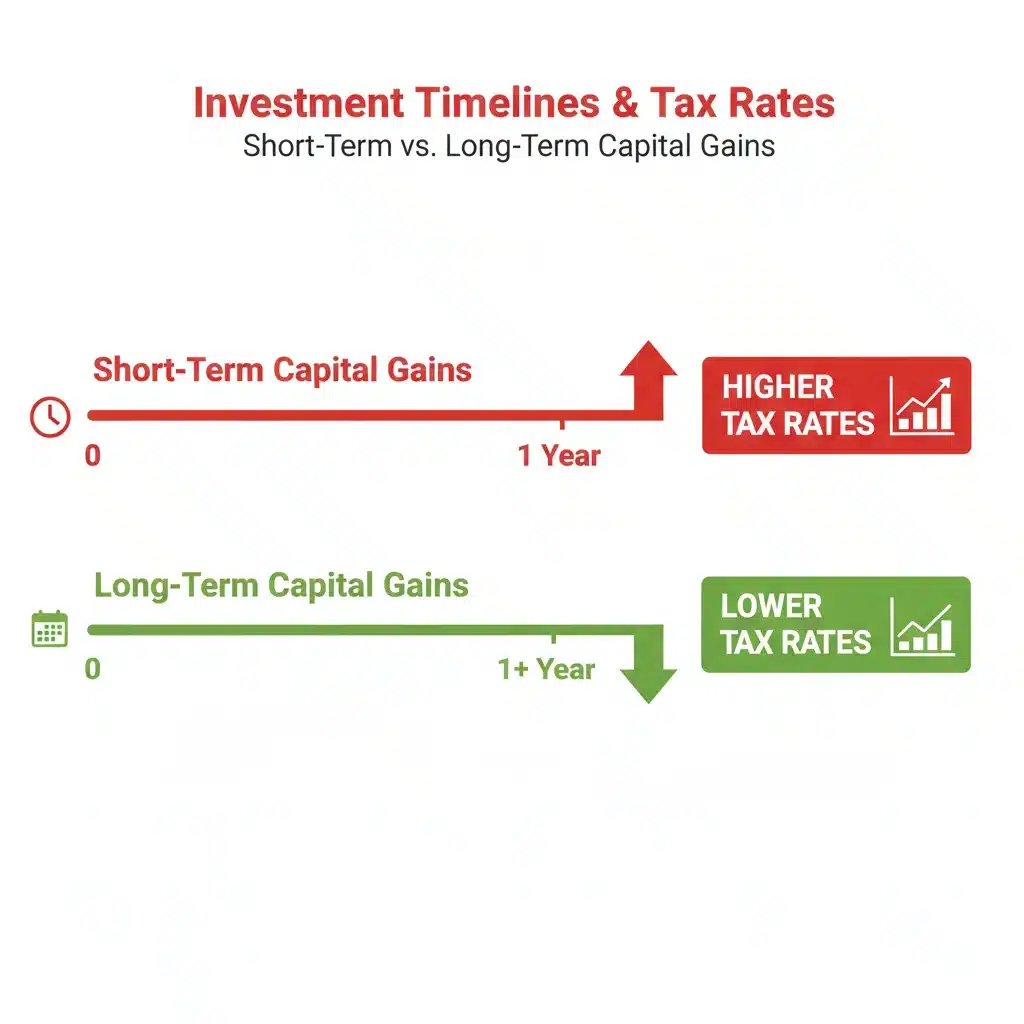
Understanding this fundamental difference is crucial for any investor. Holding an asset for just a few extra days to cross the one-year mark can sometimes mean the difference between paying a significantly higher ordinary income tax rate and a much lower long-term capital gains rate. This simple concept forms the bedrock of many capital gains tax minimization strategies.
Current Capital Gains Tax Rates (Projected for 2026)
While the exact tax brackets and rates for 2026 will be finalized closer to the date, we can project based on current law and expected inflation adjustments. It’s important to consult official IRS publications or a tax professional for the most up-to-date figures when filing. However, the structure is likely to remain as follows:
Ordinary Income Tax Rates (for Short-Term Capital Gains)
Short-term capital gains are added to your ordinary income and taxed at the marginal rates applicable to your income bracket. These rates can range from 10% to 37% (or potentially higher if legislative changes occur). Your specific rate depends on your filing status (single, married filing jointly, head of household, etc.) and your total taxable income.
Preferential Long-Term Capital Gains Rates
For long-term capital gains, the rates are generally more favorable:
- 0% Rate: Applies to taxpayers whose taxable income falls below a certain threshold. For 2026, this threshold will likely be adjusted upwards from previous years. This is a significant opportunity for individuals with lower incomes, allowing them to realize long-term gains tax-free.
- 15% Rate: This is the most common long-term capital gains rate, applying to a broad range of middle-income taxpayers.
- 20% Rate: This rate applies to high-income taxpayers whose taxable income exceeds a higher threshold.
It’s also important to remember that certain types of capital gains, such as those from collectibles or qualified small business stock, may be subject to different rates. For instance, gains from collectibles (like art, antiques, or rare coins) are typically taxed at a maximum rate of 28%.
Net Investment Income Tax (NIIT)
Beyond the standard capital gains tax rates, high-income earners must also consider the Net Investment Income Tax (NIIT). This is a 3.8% tax on certain net investment income for individuals, estates, and trusts whose income exceeds specific thresholds. For individuals, these thresholds are generally $200,000 for single filers and $250,000 for married filing jointly. This tax can apply to both short-term and long-term capital gains, effectively increasing your overall tax burden if your income is above these limits. Planning for the NIIT is an integral part of comprehensive capital gains tax strategy for those affected.
Strategic Approaches to Minimizing Capital Gains Tax in 2026
Now that we’ve covered the basics, let’s explore practical strategies you can employ to minimize your capital gains tax liability in 2026. These strategies range from simple timing adjustments to more complex financial instruments and accounts.
1. Hold Assets for More Than One Year (Long-Term Strategy)
This is arguably the simplest yet most effective strategy. As discussed, holding an asset for more than 365 days transforms a short-term capital gain into a long-term capital gain, subjecting it to significantly lower tax rates. Before selling an asset, always check your holding period. If you are close to the one-year mark, delaying the sale for a few weeks or months could result in substantial tax savings. This strategy requires patience but offers a clear financial advantage.
2. Utilize Tax-Loss Harvesting
Tax-loss harvesting involves strategically selling investments at a loss to offset capital gains and, potentially, a limited amount of ordinary income. Here’s how it works:
- Offsetting Gains: Capital losses can first be used to offset any capital gains you have realized during the year. For example, if you have $10,000 in capital gains and $7,000 in capital losses, your net capital gain for tax purposes would be $3,000.
- Offsetting Ordinary Income: If your capital losses exceed your capital gains, you can use up to $3,000 of the remaining loss to offset your ordinary income (e.g., salary, wages).
- Carryforward Losses: Any capital losses exceeding the $3,000 ordinary income limit can be carried forward indefinitely to offset future capital gains and ordinary income.

Tax-loss harvesting is typically performed towards the end of the year, but it can be done at any point. However, be mindful of the “wash-sale rule,” which prohibits you from claiming a loss on a security if you buy a substantially identical security within 30 days before or after the sale. This rule prevents taxpayers from claiming a loss while maintaining continuous ownership of a particular investment.
3. Invest in Tax-Advantaged Accounts
Many investment vehicles offer significant tax advantages that can help reduce or defer capital gains tax. These accounts are cornerstones of effective long-term financial planning:
- 401(k)s and IRAs: Contributions to traditional 401(k)s and IRAs are often tax-deductible, and investments grow tax-deferred. You won’t pay capital gains tax until you withdraw funds in retirement, at which point they are taxed as ordinary income. This deferral allows your investments to compound more effectively over time.
- Roth IRAs and Roth 401(k)s: While contributions to Roth accounts are made with after-tax dollars, qualified withdrawals in retirement are entirely tax-free. This means any capital gains earned within the Roth account are never taxed, offering immense long-term benefits, especially if you expect to be in a higher tax bracket in retirement.
- 529 Plans: Designed for education savings, investments in 529 plans grow tax-deferred, and qualified withdrawals for educational expenses are tax-free. This can be an excellent way to save for college without incurring capital gains tax on your investment growth.
- Health Savings Accounts (HSAs): HSAs offer a triple tax advantage: tax-deductible contributions, tax-free growth, and tax-free withdrawals for qualified medical expenses. If used as an investment vehicle, the gains within an HSA are never taxed, making it one of the most powerful tax-advantaged accounts available.
Maximizing contributions to these accounts should be a priority for anyone looking to reduce their overall tax burden, including capital gains.
4. Consider Qualified Opportunity Funds (QOFs)
Created by the Tax Cuts and Jobs Act of 2017, Qualified Opportunity Funds offer a unique way to defer and potentially reduce capital gains tax. By investing realized capital gains into a QOF, which in turn invests in economically distressed areas (Opportunity Zones), investors can:
- Defer Capital Gains: Defer tax on the original capital gain until December 31, 2026, or until the QOF investment is sold, whichever comes first.
- Reduce Original Gain: If the investment is held for at least five years, the deferred capital gain is reduced by 10%. If held for seven years, it’s reduced by 15%.
- Eliminate Future Gains: If the QOF investment is held for at least ten years, any capital gains earned from the QOF investment itself are entirely tax-free.
QOFs are complex and involve specific risks, but for investors with significant capital gains, they can provide substantial tax benefits. It’s crucial to consult with a financial advisor specializing in QOFs to determine if this strategy aligns with your financial goals and risk tolerance.
5. Donate Appreciated Assets to Charity
If you’re charitably inclined, donating appreciated assets (like stocks or mutual funds) that you’ve held for more than a year can be a highly tax-efficient strategy. If you donate appreciated stock directly to a qualified charity, you can:
- Avoid Capital Gains Tax: You typically won’t pay capital gains tax on the appreciation of the donated asset.
- Claim a Tax Deduction: You can generally deduct the fair market value of the appreciated asset (up to certain limits) from your taxable income.
This dual benefit makes charitable giving of appreciated assets a powerful tool for tax planning, allowing you to support causes you care about while reducing your capital gains tax liability.
6. Utilize the Primary Residence Exclusion
For homeowners, the sale of a primary residence offers a significant capital gains exclusion. If you meet certain criteria, you can exclude up to $250,000 of capital gain ($500,000 for married couples filing jointly) from your taxable income. To qualify, you must have owned and lived in the home as your primary residence for at least two of the five years leading up to the sale.
This exclusion can be used multiple times, provided you meet the eligibility requirements each time. It’s a critical benefit for homeowners and a key consideration when planning to sell your home.
7. Consider an Installment Sale
An installment sale allows you to spread the recognition of a capital gain over several tax years, rather than recognizing the entire gain in the year of sale. This occurs when you receive at least one payment for the property after the tax year in which the sale occurred. By deferring income, you might be able to:
- Stay in a Lower Tax Bracket: Spreading the gain could keep you in a lower capital gains tax bracket each year, rather rallied than pushing you into a higher one with a single large gain.
- Defer Tax Payment: You pay tax as you receive payments, providing cash flow benefits.
Installment sales can be complex, and specific rules apply, so professional guidance is advisable.
8. Gift Appreciated Assets
Gifting appreciated assets to individuals in lower tax brackets can be a viable strategy, particularly for family wealth planning. If you gift an asset to someone who is in the 0% or 15% long-term capital gains tax bracket, and they subsequently sell it after holding it for more than a year (and the one-year mark from your original purchase date), the gain could be taxed at their lower rate.
However, be aware of gift tax rules and annual gift tax exclusions. For 2026, the annual gift tax exclusion will likely be adjusted for inflation, but it allows you to gift a certain amount to any individual without incurring gift tax or using up your lifetime exclusion. The recipient receives the asset with your original cost basis (a ‘carryover basis’).
9. Estate Planning and Step-Up in Basis
For appreciated assets held until death, the ‘step-up in basis’ rule is a significant tax advantage for heirs. When an individual inherits an asset, its cost basis is ‘stepped up’ to its fair market value on the date of the original owner’s death. This means that if the heir sells the asset shortly after inheriting it, they will typically pay little to no capital gains tax on the appreciation that occurred during the original owner’s lifetime.
This rule is a crucial consideration in estate planning, as it allows wealth to be transferred more tax-efficiently than if the original owner sold the assets during their lifetime and passed on the cash. It underscores the benefit of holding highly appreciated assets until death for estate planning purposes.
10. Rebalance Your Portfolio Strategically
Regular portfolio rebalancing is essential for maintaining your desired asset allocation. When rebalancing, rather than simply selling appreciated assets, consider utilizing tax-loss harvesting opportunities or making new investments in tax-advantaged accounts. If you must sell appreciated assets, ensure you’ve held them for more than a year to qualify for long-term capital gains rates.
A strategic approach to rebalancing can involve selling assets that have generated losses to offset gains from assets you need to sell to rebalance, thereby minimizing your overall capital gains tax liability.
Important Considerations and Potential Changes for 2026
While the strategies outlined above are generally robust, the tax code is subject to change. As we approach 2026, it’s vital to stay informed about any potential legislative developments that could impact capital gains tax rates or rules. Historically, there have been proposals to:
- Increase Capital Gains Tax Rates: Especially for high-income earners, there are often discussions about aligning long-term capital gains rates more closely with ordinary income tax rates.
- Adjust Holding Periods: While less common, changes to the one-year holding period for long-term gains could theoretically occur.
- Modify Step-Up in Basis: The step-up in basis rule has been a subject of debate, with some proposals suggesting its elimination or modification for very large estates.
Staying abreast of these potential changes through reputable financial news sources and consulting with tax professionals is paramount. Proactive planning based on anticipated changes can help you adjust your strategies in advance.
The Role of Professional Advice
While this guide provides a comprehensive overview of capital gains tax and minimization strategies for 2026, it is not a substitute for personalized professional advice. Tax laws are complex, and your individual financial situation, investment portfolio, and risk tolerance are unique. A qualified financial advisor or tax professional can:
- Assess Your Specific Situation: Provide tailored advice based on your income, assets, and financial goals.
- Identify Optimal Strategies: Help you choose the most effective tax-minimization strategies for your particular circumstances.
- Ensure Compliance: Help you navigate complex IRS rules and regulations, ensuring you remain compliant while maximizing your tax efficiency.
- Stay Updated: Keep you informed about any changes to tax law that could affect your capital gains liability.
Engaging with a professional can help you avoid costly mistakes and unlock opportunities you might otherwise overlook.
Conclusion: Proactive Capital Gains Tax Planning for 2026
Navigating capital gains tax in 2026 requires a proactive and informed approach. By understanding the distinction between short-term and long-term gains, staying aware of the applicable tax rates and thresholds, and strategically implementing various minimization techniques, you can significantly reduce your tax burden.
Whether it’s by extending holding periods, utilizing tax-loss harvesting, investing in tax-advantaged accounts, or exploring more advanced strategies like Qualified Opportunity Funds and charitable giving, the tools are available to help you keep more of your investment profits. Remember that tax planning is an ongoing process, not a one-time event. Regular review of your portfolio and financial plan, coupled with expert advice, will position you for optimal tax efficiency and financial success in 2026 and beyond.
Start planning today to ensure your investments work harder for you, not just for the taxman. The future of your financial health depends on diligent and intelligent capital gains tax management.