Your 2026 Guide to Financial Wellness Tools and Resources (Comparison/Analysis)

In an increasingly complex financial world, achieving and maintaining financial wellness has become a paramount goal for individuals and families worldwide. The year 2026 brings with it a new wave of innovative financial wellness tools and resources designed to empower you to take control of your financial destiny. Whether you’re grappling with debt, striving to save for a down payment, planning for retirement, or simply aiming for better everyday money management, the right tools can make all the difference. This comprehensive guide will delve into the leading financial wellness tools available, offering a detailed comparison and analysis to help you navigate your options and select the best fit for your unique financial journey.
Financial wellness is more than just having a healthy bank account; it’s about having a holistic sense of security and control over your financial life. It encompasses everything from budgeting and saving to investing, debt management, and even financial education. As technology continues to evolve at a rapid pace, so too do the solutions available to support these critical areas. From AI-powered budgeting apps to sophisticated investment platforms and personalized financial coaching, the landscape of financial wellness tools is richer and more accessible than ever before. Our goal is to cut through the noise and provide you with actionable insights into the most effective and user-friendly options.
Understanding the Core Pillars of Financial Wellness
Before we dive into specific financial wellness tools, it’s crucial to understand the foundational pillars that define true financial wellness. These pillars serve as benchmarks against which the effectiveness of any tool can be measured:
- Budgeting and Cash Flow Management: The ability to track income and expenses, create a realistic budget, and ensure that your outgoing cash does not exceed your incoming funds. This is the bedrock of financial stability.
- Savings and Emergency Funds: Building a robust savings cushion for unexpected events and future goals, such as a down payment, education, or a significant purchase.
- Debt Management: Strategically reducing and eliminating high-interest debt, understanding different debt types, and developing a plan for becoming debt-free.
- Investing and Wealth Growth: Making your money work for you through various investment vehicles, understanding risk tolerance, and planning for long-term wealth accumulation, including retirement.
- Financial Education and Literacy: Continuously learning about personal finance, understanding economic principles, and making informed decisions.
- Financial Protection: Ensuring you have adequate insurance (health, life, disability, property) to protect against unforeseen circumstances.
\
Each of the financial wellness tools we will explore aims to address one or more of these pillars, providing specialized features to help you achieve your objectives. By understanding your own financial needs and goals, you can better identify which tools will be most beneficial.
The Evolution of Financial Wellness Tools: What’s New in 2026?
The financial technology (FinTech) sector has seen explosive growth, and 2026 continues this trend with advancements that make personal finance management more intuitive, personalized, and proactive. Here’s what’s distinguishing the current generation of financial wellness tools:
- AI and Machine Learning Integration: AI-powered insights are no longer a novelty. Many tools now use machine learning to analyze spending patterns, predict future expenses, identify potential savings, and even offer personalized financial advice, moving beyond simple data aggregation.
- Hyper-Personalization: Generic advice is out. The best financial wellness tools offer highly customized recommendations based on your individual income, expenses, goals, and risk tolerance, adapting as your financial situation changes.
- Gamification and Behavioral Economics: To keep users engaged, many platforms incorporate game-like elements, challenges, and rewards to encourage positive financial habits. Behavioral economics principles are applied to nudge users towards better decisions.
- Seamless Integration: Modern tools boast impressive integration capabilities, connecting with multiple bank accounts, credit cards, investment platforms, and even real estate data, providing a holistic view of your financial life from a single dashboard.
- Enhanced Security and Privacy: With increasing cyber threats, leading financial wellness tools are prioritizing robust encryption, multi-factor authentication, and transparent data privacy policies to protect user information.
- Focus on Financial Coaching and Education: Beyond just tracking, many platforms now offer integrated educational content, webinars, and even access to certified financial planners to improve financial literacy.
\
\
Category 1: Budgeting and Expense Tracking Tools
Effective budgeting is the cornerstone of financial wellness. These tools help you understand where your money goes, identify areas for savings, and stay on track with your financial goals.
Top Budgeting Apps for 2026: Comparison
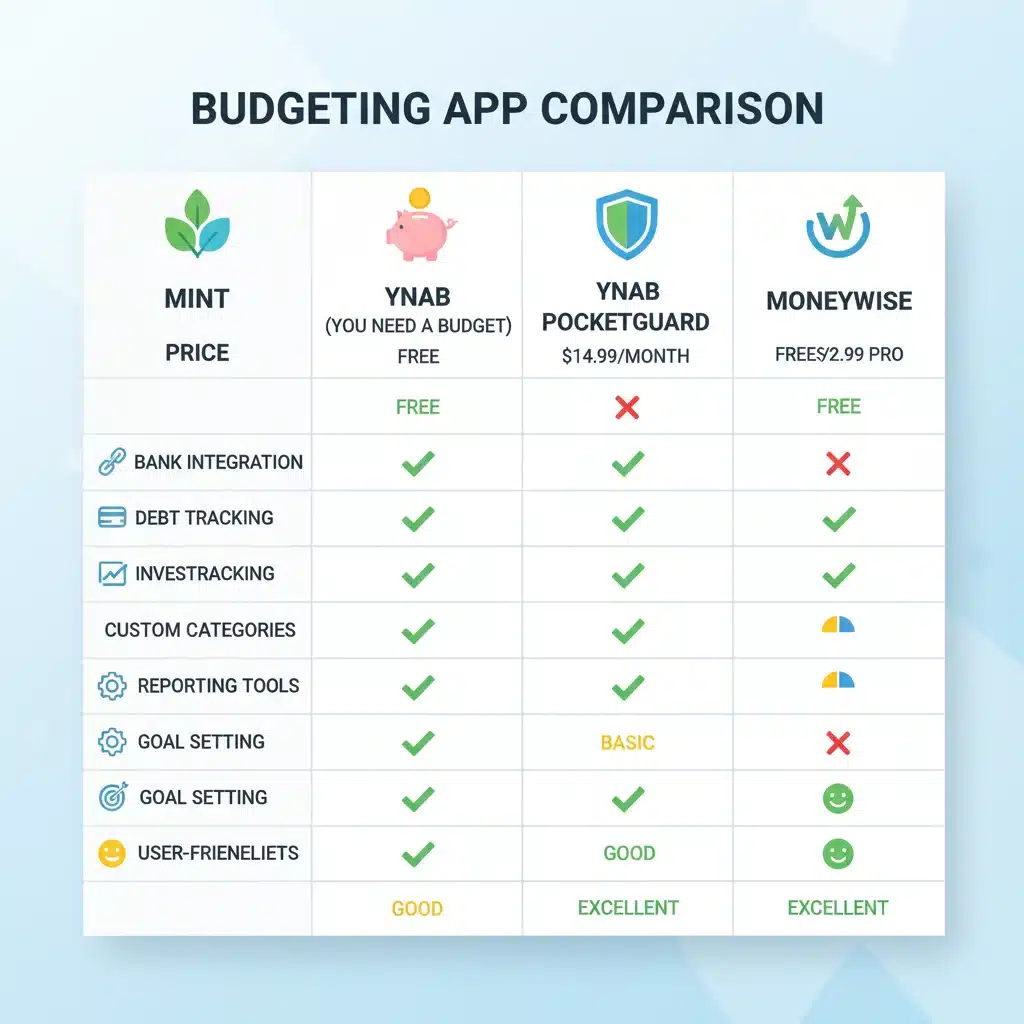
Let’s compare some of the most popular and effective budgeting financial wellness tools:
-
Mint (Intuit): Still a powerhouse in 2026, Mint continues to offer a free, comprehensive overview of your finances. It connects to all your accounts, categorizes transactions, tracks bills, and provides budget recommendations. Its strength lies in its user-friendly interface and robust reporting features. New in 2026 are enhanced AI-driven insights for predicting future cash flow and suggesting personalized savings opportunities based on your spending habits.
-
You Need A Budget (YNAB): YNAB operates on a ‘zero-based budgeting’ philosophy, where every dollar is assigned a job. This approach is highly effective for those who want strict control over their spending. While it has a subscription fee, many users find the discipline it instills well worth the cost. In 2026, YNAB has improved its mobile experience and added more advanced goal-setting features, allowing for complex financial planning scenarios.
-
PocketGuard: This app focuses on telling you ‘how much you have left to spend’ after accounting for bills, savings goals, and necessary expenses. It’s excellent for those who want a quick, clear picture of their disposable income. PocketGuard in 2026 offers better integration with investment accounts, providing a more complete financial snapshot beyond just budgeting.
-
Simplifi by Quicken: Simplifi offers a sleek, modern interface for budgeting, spending tracking, and financial planning. It’s known for its customizable spending plans and real-time insights. The 2026 version boasts improved AI for identifying recurring subscriptions you might want to cancel and more detailed net worth tracking features.
-
Fudget: For those who prefer simplicity, Fudget is a no-frills, manual budgeting app. It doesn’t connect to bank accounts, requiring you to input data manually. This can be a pro for privacy-conscious users or those who find automated categorization overwhelming. Its 2026 update focuses on cross-device syncing and a cleaner, faster entry system.
Key Considerations When Choosing a Budgeting Tool:
- Automation vs. Manual Entry: Do you prefer automatic synchronization with your bank accounts or a more hands-on approach?
- Cost: Are you looking for a free app or willing to pay for advanced features?
- Budgeting Philosophy: Does the app’s approach (e.g., zero-based, envelope system) align with your financial style?
- Features: Do you need bill tracking, goal setting, net worth tracking, or just basic expense monitoring?
- Security: Always verify the security measures and data encryption protocols of any app you use.
\
\
\
\
Category 2: Investment and Wealth Management Platforms
Once your budget is in order and you’ve built an emergency fund, the next step in financial wellness is often growing your wealth through investments. The financial wellness tools in this category range from robo-advisors for passive investors to full-service brokerage platforms for the more hands-on.
Leading Investment Platforms in 2026: An Analysis
-
Betterment: A pioneer in robo-advisory services, Betterment continues to be a top choice for automated investing. It builds diversified portfolios based on your risk tolerance and goals, automatically rebalances them, and handles tax-loss harvesting. In 2026, Betterment has expanded its ethical investing options and introduced more personalized financial planning tools that integrate with your other financial data.
-
Wealthfront: Similar to Betterment, Wealthfront offers sophisticated automated investing with a focus on maximizing returns and minimizing taxes. It’s known for its Path financial planning tool, which projects your financial future based on your current inputs. The 2026 iteration features enhanced AI for predicting market trends and offering proactive portfolio adjustments, along with improved cryptocurrency investment options.
-
Fidelity Go: Fidelity’s answer to robo-advisors, Fidelity Go provides professionally managed portfolios with a low minimum investment. It’s a great option for those who want the backing of a traditional financial institution with the convenience of automation. Updates in 2026 include deeper integration with Fidelity’s broader suite of financial products and more granular control over investment preferences within managed portfolios.
-
Vanguard Personal Advisor Services: For those who want a blend of automated investing and human advice, Vanguard offers a compelling solution. You get access to a financial advisor who can help with complex financial planning while your investments are managed by Vanguard’s low-cost index funds and ETFs. The 2026 service now includes more frequent check-ins and enhanced digital tools for collaborating with your advisor.
-
M1 Finance: M1 Finance combines automated investing with self-directed trading, allowing you to create custom portfolios (‘Pies’) that are automatically rebalanced. It’s ideal for investors who want control over their asset allocation but appreciate automated execution. New features in 2026 include advanced options for margin lending and a more intuitive interface for building complex investment strategies.
-
Acorns: This micro-investing app rounds up your everyday purchases to the nearest dollar and invests the spare change. It’s perfect for beginners or those who want to start investing without feeling the pinch. Acorns in 2026 has added more diversified portfolio options, including ESG (Environmental, Social, and Governance) funds, and expanded its ‘Found Money’ partnerships.

Choosing Your Investment Tool: What to Consider
- Investment Style: Are you a passive investor looking for automation, or do you prefer to be more hands-on?
- Fees: Understand management fees, trading commissions, and expense ratios of funds.
- Minimum Investment: Some platforms require a higher initial deposit than others.
- Access to Advice: Do you want human financial advice or are you comfortable with purely automated guidance?
- Features: Look for tax-loss harvesting, rebalancing, goal planning, and diverse investment options.
\
\
\
\
Category 3: Debt Management and Credit Building Resources
Debt can be a significant barrier to financial wellness. Fortunately, several financial wellness tools are specifically designed to help you tackle debt and build a strong credit profile.
Effective Debt Management and Credit Building Tools for 2026:
-
Undebt.it: This free web-based tool helps you create a customized debt payoff plan using methods like the debt snowball or debt avalanche. It allows you to track your progress and visualize your debt-free date. The 2026 version offers improved integration with budgeting apps for more accurate payment tracking and forecasting.
-
Tally: Tally acts as a debt manager, helping you pay down high-interest credit card debt. It can identify your credit cards, analyze your interest rates, and even offer a lower-interest line of credit to consolidate your debt. In 2026, Tally has expanded its partnerships with lenders to offer even more competitive rates and enhanced its AI to proactively suggest optimal payment strategies.
-
Credit Karma: While primarily known for free credit scores and reports, Credit Karma also offers tools to monitor your credit, identify factors impacting your score, and recommend financial products that align with your credit profile. Its 2026 update includes more personalized advice for improving specific aspects of your credit score and better tools for disputing inaccuracies.
-
Experian Boost: This free service allows you to potentially increase your FICO score by including eligible on-time payments for things like utility bills, phone bills, and streaming services. It’s an innovative way to leverage your existing payment history. Experian Boost in 2026 has broadened the types of payments it can consider, making it more accessible to a wider range of users.
-
Payoff (by Happy Money): Payoff offers personal loans specifically designed to consolidate and pay off credit card debt. It focuses on helping you achieve financial freedom through a single, fixed-rate loan. The 2026 offering includes more flexible repayment terms and improved financial education resources to prevent future debt accumulation.
Selecting the Right Debt and Credit Tool:
- Type of Debt: Are you dealing with credit card debt, student loans, or a mix?
- Your Approach: Do you need a strict plan, consolidation, or just credit monitoring?
- Cost: Many tools are free, but some consolidation services or loans have fees/interest.
- Credit Score Impact: Understand how each tool might affect your credit score, both positively and negatively.
\
\
\
Category 4: Financial Education and Planning Resources
Knowledge is power, especially when it comes to personal finance. These financial wellness tools and resources are dedicated to enhancing your financial literacy and helping you plan for major life events.
Leading Financial Education and Planning Resources in 2026:
-
NerdWallet: Beyond product comparisons, NerdWallet offers a vast library of articles, guides, and tools covering every aspect of personal finance, from mortgages to investing. It’s an excellent free resource for unbiased information. In 2026, NerdWallet has introduced more interactive calculators and personalized learning paths based on user queries and financial goals.
-
Khan Academy: While known for general education, Khan Academy has an extensive and free personal finance section. It breaks down complex topics into easy-to-understand videos and exercises. The 2026 curriculum includes updated modules on cryptocurrency, sustainable investing, and the gig economy’s financial implications.
-
Certified Financial Planners (CFPs) via Online Platforms: Services like Facet Wealth and Vanguard Personal Advisor Services connect you with human CFPs for comprehensive financial planning, retirement planning, tax strategies, and estate planning. They offer a hybrid approach, combining technology with expert human advice. These platforms in 2026 offer more flexible meeting schedules and virtual collaboration tools.
-
Personal Capital (now Empower Personal Wealth): This platform offers a powerful free dashboard to track your net worth, investments, and spending. For those with higher asset levels, it provides access to human financial advisors. The 2026 iteration has further refined its retirement planning calculator and introduced more advanced tax optimization strategies.
-
Podcasts and Books: Don’t underestimate the power of traditional and digital media. Podcasts like ‘The Ramsey Show,’ ‘Afford Anything,’ and ‘ChooseFI’ continue to offer valuable insights. Books by authors like Dave Ramsey, Ramit Sethi, and Suze Orman remain foundational resources. The 2026 landscape sees an increase in podcasts focusing on niche financial topics and diverse perspectives.
How to Leverage Financial Education Tools:
- Identify Knowledge Gaps: What areas of finance do you feel least confident about?
- Set Learning Goals: Do you want to understand investing, retirement, or debt better?
- Consistency: Dedicate regular time to learning, whether it’s 15 minutes a day or an hour a week.
- Apply What You Learn: The best way to learn is by doing. Use your new knowledge to make informed decisions.
\
\
\
Integrated Financial Wellness Platforms: The All-in-One Solution
For those seeking a more consolidated approach, some platforms aim to be an all-encompassing hub for your financial life, integrating budgeting, investing, debt management, and education.
-
Empower Personal Wealth (formerly Personal Capital): As mentioned, Empower offers a free financial dashboard that aggregates all your accounts. For a fee, they provide personalized financial advisory services covering investment management, retirement planning, and more. Their 2026 platform has improved its predictive analytics for life events and offers more granular control over financial projections.
-
Fidelity Full View (powered by eMoney Advisor): This free tool from Fidelity allows you to link all your financial accounts – even those outside of Fidelity – to get a complete picture of your net worth, spending, and investments. It’s a robust aggregator that can serve as a central hub. The 2026 version has enhanced goal-tracking capabilities and better integration with Fidelity’s trading platforms.
-
MaxMyInterest: While not an ‘all-in-one’ in the traditional sense, MaxMyInterest optimizes your cash savings by automatically moving funds to the highest-yielding FDIC-insured bank accounts. It’s a powerful tool for maximizing the interest earned on your emergency fund and other liquid savings without having to manually transfer funds. Its 2026 updates include partnerships with more banks and enhanced security features.
The Future of Financial Wellness: Trends Beyond 2026
As we look beyond 2026, several trends are poised to further shape the landscape of financial wellness tools:
- Embedded Finance: Financial services will become seamlessly integrated into non-financial platforms, making financial management an almost invisible part of your daily life. Think banking services directly within your e-commerce platform.
- Personalized Financial AI Assistants: More sophisticated AI will act as your personal CFO, offering proactive advice, executing transactions, and even negotiating on your behalf based on your financial goals and preferences.
- Blockchain and Decentralized Finance (DeFi): While still nascent for mainstream personal finance, blockchain technology could revolutionize how assets are managed, transferred, and secured, offering new avenues for investing and borrowing.
- Greater Emphasis on ESG Investing: Expect more financial wellness tools to prioritize and simplify Environmental, Social, and Governance (ESG) investing, allowing users to align their investments with their values.
- Financial Wellness as an Employee Benefit: More companies will offer comprehensive financial wellness programs and tools as part of their employee benefits package, recognizing the link between employee financial health and productivity.
\
\
\
\
\
Conclusion: Choosing Your Path to Financial Wellness
The journey to financial wellness is deeply personal, and the array of financial wellness tools available in 2026 reflects this diversity. There is no one-size-fits-all solution; the best tools for you will depend on your current financial situation, your goals, your comfort level with technology, and your preferred level of involvement.
Start by assessing your needs. Are you struggling with debt? Do you need a clearer picture of your spending? Are you ready to start investing? Once you identify your primary financial challenges and aspirations, you can begin to explore the categories and specific tools that align best with those objectives. Many tools offer free trials or basic versions, allowing you to test them out before committing.
Remember that tools are just that – tools. They are most effective when coupled with consistent effort, discipline, and a genuine commitment to improving your financial health. Leverage these innovative financial wellness tools to gain clarity, automate processes, educate yourself, and ultimately, build a more secure and prosperous financial future. The year 2026 is an opportune time to embark on or accelerate your financial wellness journey, equipped with an unprecedented array of powerful resources at your fingertips.
Take the first step today. Research, compare, and choose the financial wellness tools that resonate with your unique path. Your future self will thank you.
Author